
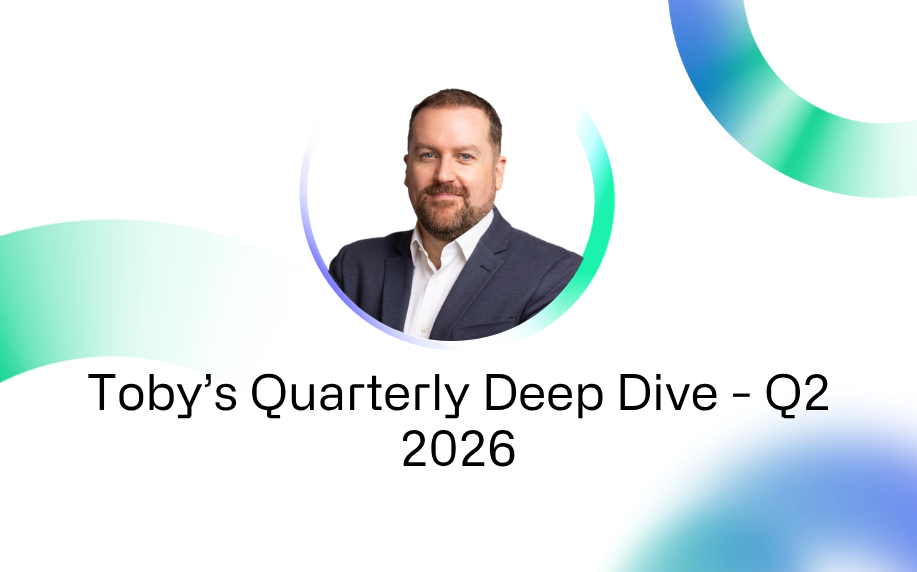
Toby Larkman, Managing Director, Wealthtime
The pace of change in Q2 has been impossible to ignore.
We’ve seen major pension reforms become law, targeted support move from proposal to reality and a new consultation on how advice should be delivered in the future.
On the surface, these may seem quite different.
Look a little closer, though, and they’re all responding to the same challenge.
How do we help more people make better financial decisions?
In this quarter’s Deep Dive, I share my thoughts on where our industry is heading, and how Wealthtime continues to evolve alongside it.

If there is one theme running through this quarter, it’s that the industry is moving towards providing more support to more people.
Toby Larkman, Managing Director
Technology creating more time for clients
At Wealthtime, we’re committed to investing in technology that makes life easier for you and your clients.
This quarter, we’ve introduced online JISA applications, made Wealthtime annual charges viewable directly within the platform and enabled regular SIPP income requests to be managed digitally.
As well as these new self-service options, we’ve enhanced our Capital Gains Tax Calculator, strengthened anti-money laundering checks and completed significant work behind the scenes to improve platform performance and resilience.
By removing a few more administrative tasks from your day and making routine activities easier, we hope to give you more time to focus where it really counts: your clients.
The Pension Schemes Act becomes law
The Pension Schemes Act 2026 received Royal Assent on 29 April and introduced some of the most significant changes to workplace pensions we’ve seen in years.
Much of the attention has understandably focused on the proposals affecting schemes themselves, including consolidation requirements for larger default funds and the increased emphasis on investment in private markets.
But several aspects will directly affect consumers.
Small dormant pension pots worth £1,000 or less will be consolidated automatically. Defined contribution schemes will be required to provide default retirement income solutions. Trustees will also need to demonstrate value for money across investment performance, costs and service quality.
The intention is clear: larger schemes, better oversight and more support for consumers.
The question, however, is whether better pension structures automatically lead to better retirement decisions.
I’m not convinced they do.
Your clients aren’t simply deciding when to stop working. They’re balancing income requirements, tax considerations, inheritance planning, withdrawal strategies and making their savings last throughout retirement.
And with pensions due to come within the inheritance tax framework from April 2027, those decisions become even more nuanced.
No legislation can account for every client’s circumstances, priorities and ambitions.
That’s why retirement planning remains about far more than pensions alone and why we’re seeing growing adviser demand for retirement propositions designed specifically around decumulation.
Targeted Support: Filling the Advice Gap
The introduction of targeted support on 6 April has been described by the FCA as a “once-in-a-generation” reform. [i]
The principle behind it is difficult to argue with.
Too many people are reaching retirement and facing significant financial decisions without having had any guidance whatsoever, often because they don’t know where to start.
But it’s important that we all recognise what targeted support can, and cannot, do.
It can help groups of people with similar characteristics move towards sensible next steps.
What it can’t do is understand an individual’s complete financial picture. It won’t know their family situation, broader tax position, legacy aspirations or tolerance for risk.
For me, targeted support and advice serve different purposes.
Targeted support can help people take action. Advice helps them understand what that action means for them.
And if, together, they encourage more people to seek help and engage with financial planning earlier, we all stand to benefit.
Rethinking the advice rulebook
The FCA’s consultation on simplifying investment and pension advice rules could ultimately prove to be one of the most consequential developments of the year.
The proposals seek to streamline suitability requirements into a more proportionate framework aligned with Consumer Duty principles.
For years, the industry has been asking the same question:
Can we make advice easier to deliver and more accessible without losing what makes it valuable in the first place?
I believe we can.
But only if we focus on removing unnecessary process rather than meaningful interaction.
Personally, I don’t think the value you provide clients lies in the annual review.
Its value lies in the conversations that happen because of it.
Retirement plans evolve. Families change. Businesses are sold. Health changes. And the most important financial planning adjustments are often triggered by life events rather than calendar reminders.
Whatever form the final rules take, those conversations are where the real value can be found.
Markets remind us why planning matters
Geopolitical tensions in the Middle East unsettled markets during the quarter, placing upward pressure on energy prices and inflation expectations.
Against that backdrop, the Bank of England maintained the base rate at 3.75%, while the OECD revised down its UK growth forecast for 2026.
Periods like these are useful reminders that financial planning isn’t simply about accumulating wealth during favourable market conditions.
For clients in decumulation, sequencing risk becomes particularly important.
Early market falls can have a disproportionate impact on retirement outcomes, especially when withdrawals continue throughout periods of volatility.
What strikes me in times like this is how quickly perspective becomes valuable.
Anyone can feel confident when markets are rising.
The real test comes when confidence is shaken and clients start questioning whether they should change course.
Your role isn’t simply to explain what’s happening in the markets.
It’s to help clients understand how to weather them.
Helping people stay focused on long-term goals rather than short-term headlines remains one of the most important things advisers do.
Looking ahead
If there is one theme running through this quarter, it’s that the industry is moving towards providing more support to more people.
That’s a positive step forward.
Yes, technology can improve efficiency. Regulation can widen access. And default solutions can help those who might otherwise do nothing.
But financial planning remains, at its heart, deeply human.
Looking ahead, I believe the most successful firms will be those that embrace innovation without losing the personal connection that sits at the heart of good advice.
That’s certainly how we’re thinking at Wealthtime.
Human at the front. Smart at the core.
Thank you, as always, for your continued support. I wish you, your businesses and your clients every success for the months ahead.
Toby
Get in touch with us
Speak to an expert member of the Wealthtime team to learn more:
Contact usStay connected
This article is intended for regulated financial advisers and investment professionals only. Wealthtime does not provide financial advice. This information is not intended as financial advice and should not be interpreted as such.
 linkedin
 facebook
 mail
mail