
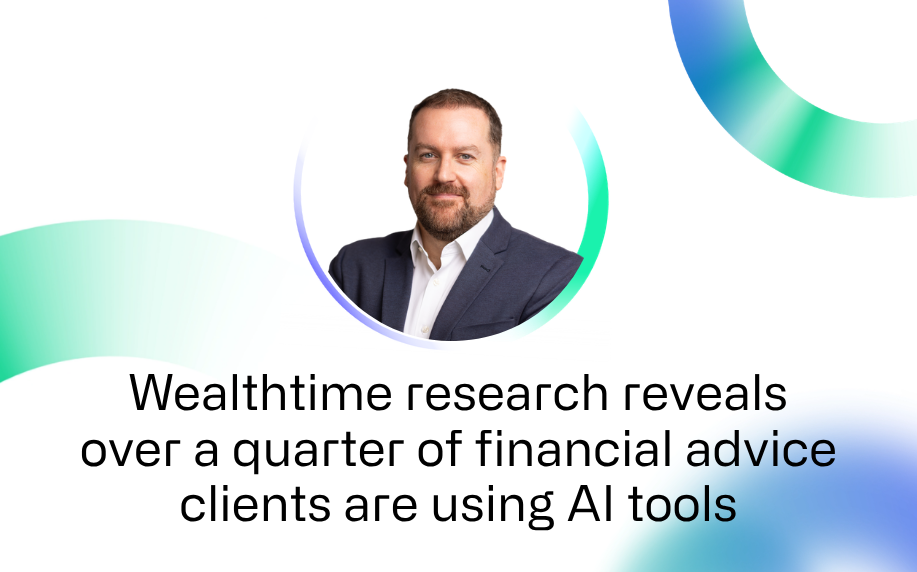
Wealthtime’s latest research reveals Artificial Intelligence (AI) is increasingly becoming part of the financial advice journey, with advisers believing more than a quarter of their clients are now using AI tools to support financial decision-making.
The findings highlight a growing trend among clients who are turning to AI platforms to research investments, prepare for adviser meetings, and even generate financial recommendations on their own. While AI is helping clients become more informed, advisers are warning that it should never replace professional financial advice.
AI is becoming part of the advice process
Research conducted by the lang cat on behalf of Wealthtime among 175 UK advice professionals, found that 63% of advisers have clients who are using AI tools in relation to their financial advice. Of those:
- 27% say clients use AI regularly
- 36% report infrequent use
- 31% suspect some clients are using AI
- Only 6% say they have no reason to believe their clients are using AI for advice purposes
On average, advisers estimate that 28% of their client base uses AI to some extent.
The findings come shortly after research from the Financial Conduct Authority (FCA), which found that four in five investors aged 18 to 40 have used AI to assist with investment decisions.
How clients are using AI
According to advisers surveyed, clients are using AI in several ways throughout the advice journey.
The most common uses include:
1. Preparing Questions Before Meetings
Nearly six in ten advisers (59%) said clients use AI tools to prepare questions before meeting with an adviser.
2. Checking or Validating Advice
Half of advisers (50%) reported that clients use AI to verify or sense-check advice they have already received.
3. Researching Financial Advice Firms
Around 44% said clients use AI to research advisory firms before an initial consultation.
4. Generating Their Own Recommendations
More concerningly, 35% of advisers said some clients are using AI tools to create investment or financial recommendations independently. One adviser described a prospective high-value client arriving at their first meeting with “a number of ideas about solutions before we started the initial conversation.”
The Risks of Relying on AI for Financial Advice
While increased engagement and financial education can benefit clients, advisers remain concerned about the risks associated with treating AI as a source of regulated financial advice.
Recent FCA research identified several misconceptions among investors:
- 44% believe AI-generated financial information is regulated
- 38% think they can make investment decisions based solely on AI-generated output
- 32% expect protection from the Financial Services Compensation Scheme (FSCS) or Financial Ombudsman Service (FOS) if AI advice proves unsuitable
These assumptions are incorrect and could expose consumers to significant risks.
The concerns are reflected in Wealthtime’s adviser survey. One adviser reported a client who had used ChatGPT for guidance on the legal and financial aspects of a divorce, only for the information to be significantly inaccurate.
Is AI a threat to financial advisers?
Despite increasing adoption of AI tools, advisers are not yet viewing the technology as a direct threat to their businesses.
Only 2% of advisers surveyed said they had lost a client because of AI usage. One respondent described AI use among clients as “very rare and not currently a threat.”
Instead, many advisers are finding that AI can help clients arrive at meetings better informed and more engaged in financial planning discussions.
AI cannot replace personalised financial advice
Toby Larkman, Managing Director at Wealthtime, believes AI can play a valuable role in helping clients prepare for advice conversations, but warns against viewing it as a substitute for professional expertise.

“AI is clearly becoming part of the advice journey, but let’s not confuse convenience with expertise. Clients are using AI to arrive at meetings better informed and with more questions, which can be a positive thing.
The danger comes when people start treating AI as a regulated adviser. AI can be impressively persuasive, even when it’s completely wrong. When it comes to life-changing financial decisions, there’s no substitute for professional advice that’s been tailored to deliver the best outcomes for the individual client.”
Toby Larkman, Managing Director
What this means for the future of advice
The research suggests that AI is rapidly becoming a standard part of how consumers engage with financial services. Rather than replacing advisers, the technology appears to be changing client behaviour, helping individuals conduct research, prepare questions and better understand financial concepts before seeking professional advice.
As AI adoption continues to grow, advisers may need to help clients understand where AI can add value and where professional expertise, regulatory oversight and personalised recommendations remain essential.
Stay connected
This article is intended for regulated financial advisers and investment professionals only. Wealthtime does not provide financial advice. This information is not intended as financial advice and should not be interpreted as such.
 linkedin
 facebook
 mail
mail