
Clients aren’t short of information. They’re short of certainty – and that’s why they wait.
Tax year end is rarely lost to laziness. It’s lost to confidence. In our study* of 1,000 advice-engaged UK adults (35+, £50k+ investable assets), the average TYE Confidence Index is 45.7/100 – and around three in ten sit in “low confidence” territory (below 40). That’s not “I’m too busy”. That’s “I’m not sure I’m doing the right thing.”
The key point for advisers is that low confidence doesn’t behave like confusion – it behaves like delay. When people worry about making a mistake, they don’t act earlier. They wait for a safer moment. Unfortunately, the “safer moment” is often late March, when admin teams are already in triage mode and client decisions get made in a narrower, riskier window.
The most useful reframe for tax year end is therefore not “maximise allowances” – it’s “reduce regret risk”. Clients are telling you what they want: clarity, a sense of control, and confidence that nothing obvious has been missed. The technical solution may be an ISA top-up, a pension contribution, a CGT realisation, or a gifting conversation. But the behavioural solution is nearly always the same – make the next step feel safe.
That’s why a “Tax Efficiency Health-Check” is such a powerful anchor. It’s not a sales pitch. It’s a confidence intervention:
- here’s what matters for you,
- here’s what we’ll check,
- here’s what we recommend doing now, and
- here’s what we can safely park until the new tax year.
The clients you’ll help most aren’t the least wealthy – they’re the least confident. And the firms that will win this season won’t be the ones with the cleverest tax angles. They’ll be the ones who turn uncertainty into a simple plan clients can actually follow and feel comfortable with.
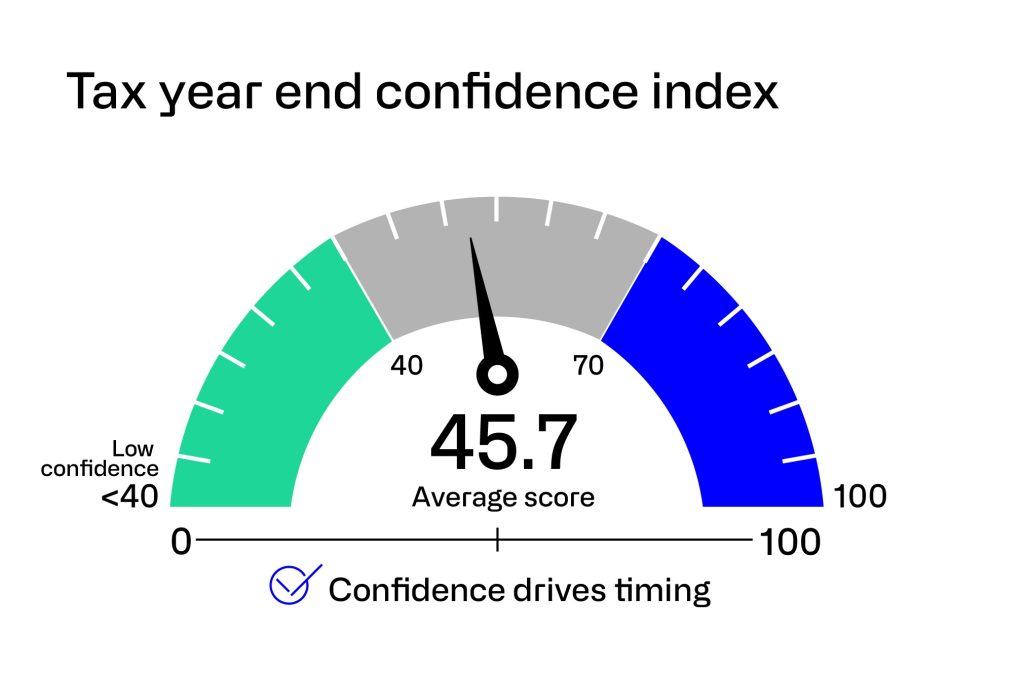
Note: The Tax Year End (TYE) Confidence Index is built from respondents’ self-reported levels of concern across a set of practical tax-year-end risks:
- Making a mistake at tax year end
- Missing an allowance or opportunity
- Not understanding the tax rules or allowances
- Not having the right information or documents in time
- Being rushed into decisions late in the process
- Ending up locked into a decision they might regret
*Based on research commissioned by Wealthtime and conducted by Ad Lucem.
The survey, conducted in January 2026 among 1,000 UK adults aged 35+ with average investable assets of £350,000, provides critical insights into the behaviours, concerns and preferences of people navigating tax year-end planning.
Please be aware that Wealthtime is not responsible for the information displayed on, or the availability of, the Ad Lucem website.
Download the reportRead the next article
For more tax year end planning top tips, read the next bitesize article.
Read nextBrowse all bitesize articles
For more expert insight and analysis, visit our tax year end library.
Visit the libraryStay connected
This article is intended for regulated financial advisers and investment professionals only.
 linkedin
 twitter
 facebook
 mail
mail