
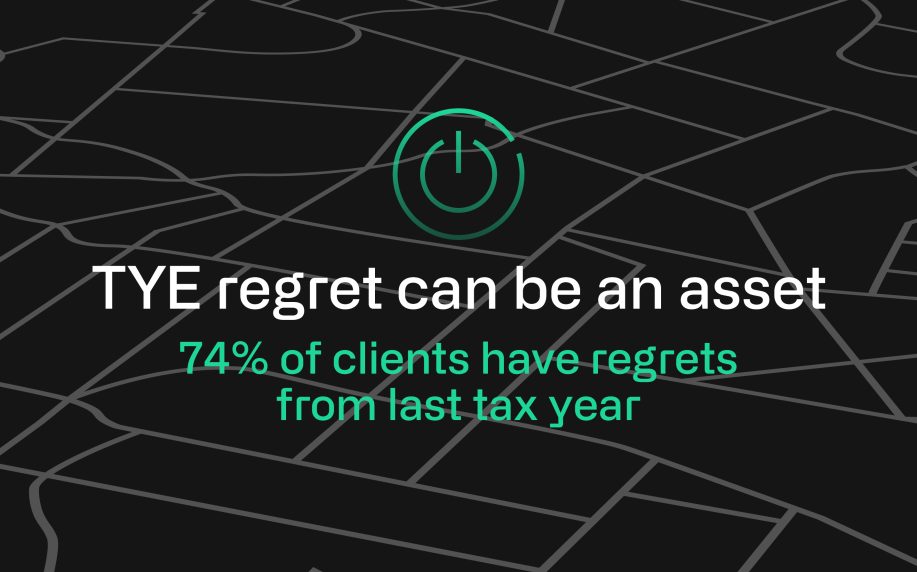
Regret Is Your Most Bankable Asset. 74% have at least one regret from last tax year. Treat that as a conversion moment – not a guilt trip.
Tax year end produces a predictable emotional hangover. People look back, realise they left things late, and wish they’d acted differently. In our study*, 74% reported at least one regret from last year’s tax year end. The most common regret isn’t “I didn’t optimise”. It’s “I felt rushed,” “I didn’t feel confident,” and “I didn’t get organised early enough.”
That matters because regret is one of the few emotions in personal finance that reliably predicts a future change in behaviour – if it is handled correctly.
Handled badly, regret becomes shame (“I’m useless with money”) and avoidance (“I don’t want to think about it”). Handled well, regret becomes a reset (“next year I’ll do it differently”).
This is where advisers can create a powerful two-step journey:
Step 1: Validate the regret
A simple line does the job:
“You’re not alone – tax year end makes people feel rushed. The goal this year is to make action feel simpler and safer.”
Step 2: Convert it into a “first 30 days” plan
The new tax year is a behavioural fresh start. Your clients’ best intentions are highest in April and May – but they decay fast unless you capture them. The smart move is to book the next check-in while the regret is still warm and the relief of “it’s done” creates openness to change.
A great practical device is the “April Advantage”: a short post-6 April checklist that moves one or two items from aspiration to habit (regular ISA funding, pension contribution settings, account consolidation, documentation readiness). The client feels progress; the firm reduces March load; the relationship deepens.
So, don’t waste regret. It’s not a negative finding – it’s the strongest evidence you have that clients want a better system. Make “less regret next year” the value proposition, and you’ll find clients surprisingly willing to engage earlier.
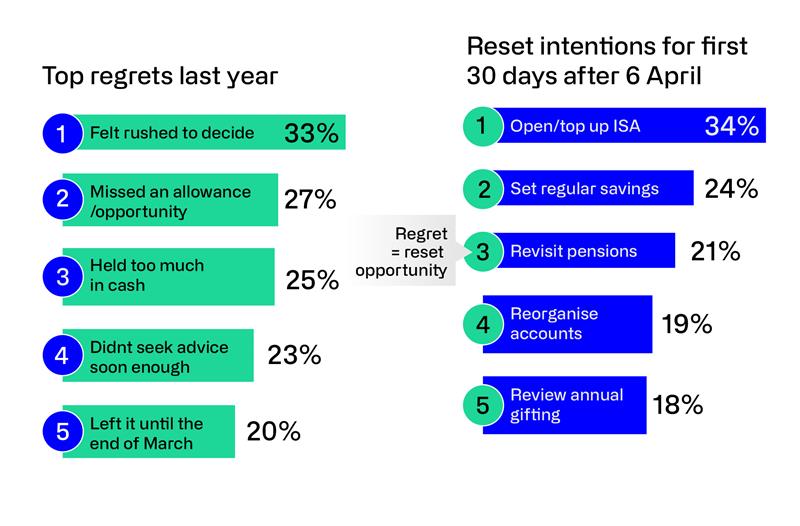
Q: “Thinking back to last tax year end, which of the following do you regret (if any)?”
Q: “In the first 30 days after 6 April, which actions are you most likely to take?”
*Based on research commissioned by Wealthtime and conducted by Ad Lucem.
The survey, conducted in January 2026 among 1,000 UK adults aged 35+ with average investable assets of £350,000, provides critical insights into the behaviours, concerns and preferences of people navigating tax year-end planning.
Please be aware that Wealthtime is not responsible for the information displayed on, or the availability of, the Ad Lucem website.
Download the reportRead the next article
For more tax year end planning top tips, read the next bitesize article.
Read nextBrowse all bitesize articles
For more expert insight and analysis, visit our tax year end library.
Visit the libraryStay connected
This article is intended for regulated financial advisers and investment professionals only.
 linkedin
 twitter
 facebook
 mail
mail