
Tony Wickenden, Technical Connection
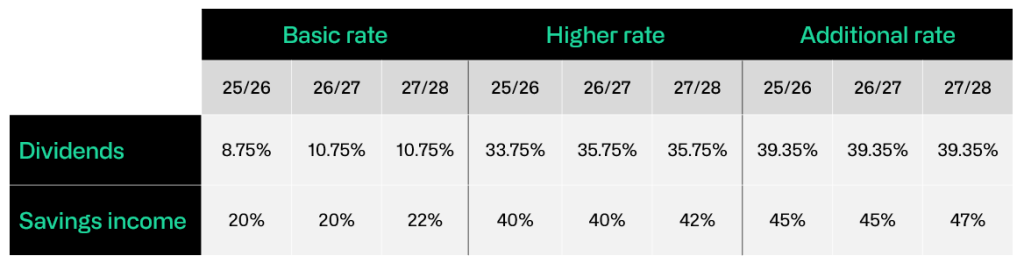
If you’re getting to the end of the tax year and finding that your client’s non-rental investment income (predominantly dividend income and interest) is bearing tax at a rate that is unacceptable to them, what can you do about it?
Well, if your point of realisation is near to the end of the tax year then (aside from pension contributions and investment in EIS and VCT – see below) there is very little that can be done. However, it should serve to create a resolve to make sure that they aren’t in the same position next year.
Here’s a checklist of some tax year start considerations that your clients could bear in mind in relation to investment income. Each one, of course, is subject to other important personal and economic considerations:
- Generate enough dividends to use your £500 “tax free” allowance. At a 4% yield you’d need a portfolio worth £12,500-£25,000 for a couple.
- Generate enough interest to use your personal savings allowance of £1,000 (basic rate taxpayer) or £500 (higher rate taxpayer). At 4% interest that’s a £25,000 deposit for a basic rate taxpayer and a £12,500 deposit for a higher rate taxpayer – additional rate taxpayers don’t qualify.
- There’s also the £5,000 zero starting rate band for savings income but this will only be relevant for those of your clients who have taxable income below the level of the personal allowance so this is unlikely to be relevant for too many of your clients.
- If you are likely to exceed those allowances and have a spouse or civil partner who will not be fully using their allowances, consider a CGT-free transfer of the income producing asset to them. Done early in, or before the start of, the tax year, you’ll get maximum benefit.
And if your clients have available funds … they could consider these investments at the tax year end: - Obviously… maximise contributions to ISA and pensions taking account of any pension relief unused in any of the three previous years that could be carried forward. No “front end” relief for the former but all income and gains generated inside the ISA wrapper will be tax free… without limit. Front end relief on your pension contributions can be an excellent way to reduce otherwise taxable income in the year.
- Subject to risk and accessibility/liquidity aspects consider investment in EIS and/or VCT to generate stand alone 30% relief on up to £200,000 invested into a VCT or £1m (and another £1m if investment is in a Knowledge Intensive company). If the VCT route appeals, then keep in mind that the rate of stand-alone relief falls to 20% from 6 April 2026.

If you’re getting to the end of the tax year and finding that your client’s non-rental investment income is bearing tax at a rate that is unacceptable to them[…] it should create a resolve to make sure that they aren’t in the same position next year.
Tony Wickenden, Technical Connection
Read the next article
For more tax year end planning top tips, read the next bitesize article.
Read nextBrowse all bitesize articles
For more expert insight and analysis, visit our tax year end library.
Visit the libraryStay connected
This article is intended for regulated financial advisers and investment professionals only.
The statements and opinions expressed in this article are those of the author and don’t necessarily reflect those of Wealthtime or any of its employees. The company does not take any responsibility for the views of the author.
The above is based on understanding of current law and HMRC practice, and Government proposals regarding future law and HMRC practice, as at 23 February 2026, and are presented for general consideration only and no action must be taken or refrained from based on the content of this article alone. Each case depends on its own facts and advice is essential. Accordingly, neither Wealthtime nor Technical Connection, nor any of their officers or employees can accept any responsibility for any loss occasioned as a result of any such action or inaction.
 linkedin
 twitter
 facebook
 mail
mail