
Clients don’t need another reminder. They need fewer hoops.
There’s a recurring myth in financial services marketing: that the right message will unlock action. Our data* suggests something more practical – and slightly less glamorous.
When clients are asked what would most increase their likelihood of taking action before 5 April, the dominant theme is not ”explain the tax rules better”. It’s “reduce the effort and uncertainty of execution”. The “winning” triggers are simple, operational and human: – a clear checklist , admin support, and a sense that someone competent is steering the process.
This is good news for advisers, because it means the path to better outcomes isn’t a brilliant new tax insight. It’s better experience design.
Think of tax year end like airport security. People don’t mind a process; they mind a process that feels chaotic and unpredictable. If the client doesn’t know what documents you need, what the next step is, or whether a decision is reversible, they default to waiting. That waiting becomes the late rush.
So, the practical playbook is surprisingly straightforward:
- One-page TYE Health-Check (what we’ll review, and what good looks like)
- A 3-step execution checklist (what you need from them, and by when)
- A decision menu (Do now / Do soon / Don’t do) to reduce cognitive load
- A named admin contact (or a clear “we will handle X” statement)
- A reassuring sentence (“This is designed to reduce regret risk – not to force decisions.”)
This is where the platform story quietly wins. Clients don’t experience tax efficiency. They experience less hassle and more certainty. If you make the process feel clean, you turn action into relief – and relief is the most underrated motivator in finance.
The press headline almost writes itself: “clients aren’t asking advisers to be more technical. They’re asking them to be more useful. The firms that remove friction will see earlier action, smoother operations, and fewer last-minute panics. And that is a genuine competitive advantage.”
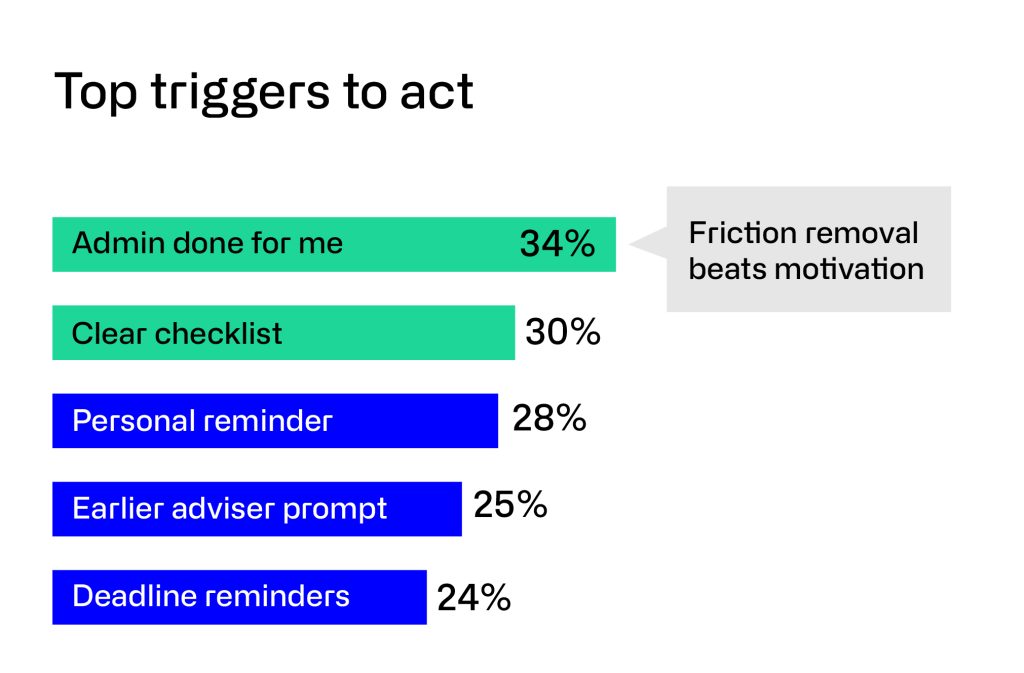
Q: Which of the following would most increase your likelihood of taking action before 5 April?
Based on research commissioned by Wealthtime and conducted by Ad Lucem.
The survey, conducted in January 2026 among 1,000 UK adults aged 35+ with average investable assets of £350,000, provides critical insights into the behaviours, concerns and preferences of people navigating tax year-end planning.
Please be aware that Wealthtime is not responsible for the information displayed on, or the availability of, the Ad Lucem website.
Download the reportRead the next article
For more tax year end planning top tips, read the next bitesize article.
Read nextBrowse all bitesize articles
For more expert insight and analysis, visit our tax year end library.
Visit the libraryStay connected
This article is intended for regulated financial advisers and investment professionals only.
 linkedin
 twitter
 facebook
 mail
mail