
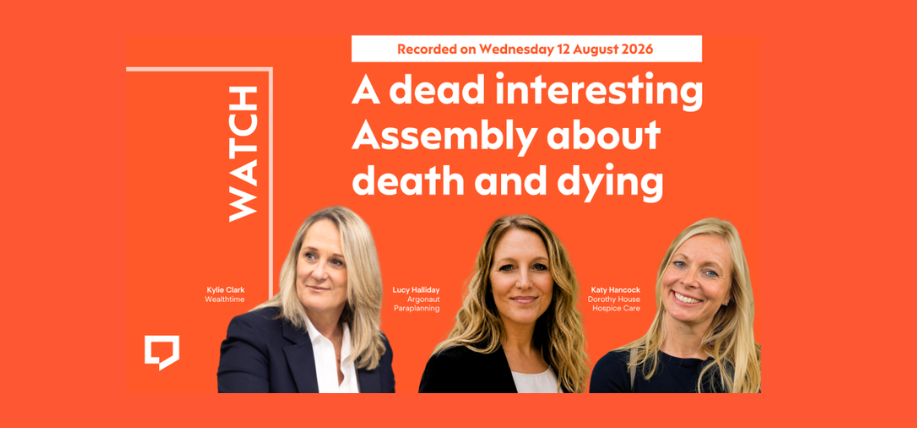
At a recent Paraplanners’ Assembly webinar, industry and care professionals explored how better conversations, better planning and better data can help clients and their families navigate one of life’s most challenging transitions.
Death is one of life’s certainties, yet it remains one of the least talked about aspects of financial planning.
That’s why we were really pleased to take part in a recent Paraplanners’ Assembly webinar on the topic ‘A Dead Interesting Assembly on Death and Dying’. Host Richard Allum was joined by three expert speakers:
- Katy Hancock, Head of Communications at Dorothy House Hospice Care
- Lucy Halliday, Senior Paraplanner at Argonaut Paraplanning
- Kylie Clark, Customer Experience Director at Wealthtime
Together, they explored how paraplanners, advisers, platforms and care professionals can best support clients and their families before, during and after bereavement. Rather than treating death as an administrative event that only happens at the end of the client relationship, the discussion challenged attendees to see it as a core part of the planning journey.
The session covered everything from powers of attorney and bereavement processes to grief, vulnerability, digital legacies and the practical realities facing families when a loved one dies. While the subject matter was serious, the underlying message was positive: better conversations today can make a huge difference tomorrow.
Five key takeaways
1. Death planning should start long before death
One of the top themes from the session was that end-of-life planning is not just about death. It’s about preparation.
Drawing on hospice experience, Katy explained that conversations about death often begin years before someone reaches their final days. A diagnosis, becoming a carer, noticing a parent’s decline, or even downsizing can all act as triggers for starting discussions.
For paraplanners, this means death should not just be reflected in a client’s will or their expression of wish forms. Instead, it should be considered as part of an ongoing life plan that helps clients maintain control, dignity and choice.
2. The biggest risks often come from not having the conversations
The panel repeatedly returned to one issue: families frequently face difficulties not because plans don’t exist, but because nobody has talked about them.
Whether that’s about funeral wishes, powers of attorney, pension nominations or access to financial accounts, uncertainty can create unnecessary stress during an already difficult time.
The speakers highlighted cases where surviving family members did not know who to contact, what assets existed and what the deceased person’s wishes were.
The message was clear: having the conversation matters just as much as having the plan.
3. Powers of attorney are only useful if they’re ready to use
One particularly practical takeaway from the session was about Lasting Powers of Attorney (LPAs).
While many clients complete LPAs, the panel noted that a common issue is that they are never formally registered. This can leave families facing lengthy and costly Court of Protection applications at precisely the point they need support and certainty.
For paraplanners, this would be a useful question to add to regular reviews: not just whether an LPA exists, but whether it has been registered and remains appropriate for the client’s circumstances.
4. Cashflow planning should include death and care scenarios
Paraplanners routinely model market downturns and investment risks, but the session challenged attendees to think more broadly. Lucy encouraged paraplanners to model scenarios such as:
- Long-term care costs
- Loss of a spouse’s income
- Reduced pension income following bereavement
- Extended periods of dependency and later-life care
Many surviving spouses experience a significant reduction in income while simultaneously facing increased financial responsibility. By incorporating these scenarios into cashflow planning, firms can help clients understand and prepare for potential outcomes before they become reality.
5. Getting data right is absolutely vital
From an investment platform perspective, Kylie highlighted the crucial role of accurate and up-to-date information.
Expressions of wish, beneficiary details, contact information and family relationships all become critically important following a death. However, records are often years out of date and things have changed. This causes unnecessary delay and confusion.
Beyond this, the panel also discussed the digital legacies, passwords, online accounts, photographs and personal information that families may struggle to access.
It’s all about understanding what data clients will leave behind – is everything up to date, and organised? It’s clear that paraplanners are uniquely placed to help clients review their information regularly, reducing complexity and stress for those left behind.
Death is part of life
Death may be unavoidable, but confusion, delays and additional stress for families don’t have to be. By encouraging earlier conversations, maintaining accurate records and helping clients prepare for later-life scenarios, paraplanners can make a real difference when it matters most.
As Katy put it during the session, “death is part of life”. The more comfortable we become discussing it, the better equipped clients and their loved ones will be when the time comes.
Catch up now
Missed the live webinar or want to watch it again? A recording and podcast version of the session are available via the Paraplanners’ Assembly website.
Watch nowUseful links
Wealthtime Bereavements Hub Wealthtime SIPP Expression of Wish form Dorothy House’s information hub for end of life planning Dorothy House’s ‘part of life’ siteThis article is intended as information only. Wealthtime does not provide financial advice.
Wealthtime is not responsible for the information displayed on, or the availability of, external websites.
 linkedin
 facebook
 mail
mail